

I recently headed back to the Peddelers Mall in Lexington, Kentucky to see if I could find more of the 1989 Bazooka sets we found there earlier this summer. The individual cards from the sets we purchased this summer have sold very well for us this year, especially those we had graded, so I decided after this trip to do a little more research on this set, this is what I have learned.
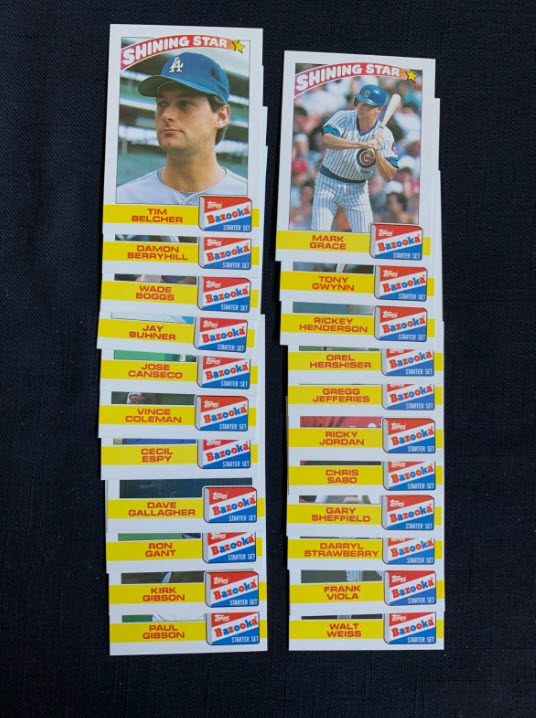
Released at a time when retro nostalgia and snack-pack tie-ins still played a big role in the hobby, the 1989 Bazooka baseball card set is a short, sweet collectible that’s part advertising relic, part player snapshot. It’s small (by trading-card standards), inexpensive, and—because it was distributed with gum and aimed at kids—keeps turning up in collections and eBay lots. Here’s everything worth knowing about the set: its composition and design, notable cards, where it came from, current market value, and why many collectors still care.
What the set is (and how big)
The 1989 Bazooka set—often listed as “Topps/Bazooka” or “Bazooka Shining Stars” on hobby sites—is a tiny, 22-card base offering that Topps produced to be packed with Bazooka gum. Unlike the big flagship Topps sets of the era, this was more of a premium promotional tie-in: short, focused, and intended for broad distribution in inexpensive gum packs and starter/card sets. The checklist includes a cross-section of late-1980s stars, rising youngsters and everyday players rather than a full season’s roster coverage.
Design and format
The cards are standard modern-size (the same general dimensions as Topps cards of the period). The fronts typically feature white borders with a prominent horizontal/yellow stripe or banner element and a simple player photo; the backs are vertically oriented with basic stats and a short blurb. Packaging was minimal—single-card gum wrappers and small starter sets (complete 22-card sets sold separately at retail or by mail) were how most collectors encountered these cards. Because they were a gum insert set rather than a flagship issue, you’ll see more wear on surviving examples—centering and edge wear from handling and the gum packaging are common, finding these cards in near mint condition can be quite a challenge.
Who’s in the set — highlights and rookies
Though short, the checklist includes several notable names from the late 1980s: Tony Gwynn, Rickey Henderson, Wade Boggs, Darryl Strawberry, Orel Hershiser and Jose Canseco appear alongside younger players of the era such as Gregg Jefferies and Gary Sheffield. The mix gives the set decent star power for its size; many of the subjects are household names for people who followed baseball in 1989. Because it’s only 22 cards, the Bazooka set is often described as a “starter” or “shining stars” promo rather than a comprehensive release. For a full checklist, see the hobby checklists and databases.
Rarity and print run
Topps didn’t publish explicit print runs for the Bazooka promo, which is typical for these auxiliary sets. The cards were printed in large numbers for mass retail distribution, so they’re not rare in a strict sense—but because they were packed with gum and handled by kids, high-grade copies (PSA 9–10) are less common than for standard hobby issues. Auction and price-guide sites show many sales but modest values, implying that these cards in high grades may be over looked and under valued.

Click Here to Check out Graded Bazooka Cards on eBay
Value and market behavior
The Bazooka cards are inexpensive in general. Ungraded singles often trade for a few dollars apiece depending on the player; the few high-demand names (Henderson, Gwynn, Boggs, Canseco) command the top of the list but rarely reach the prices of their flagship Topps counterparts from the same year, which really makes no logical snese.
Price guides and recent eBay listings show that most cards sit at bargain hobby prices, and complete 22-card sets are commonly available for modest sums on auction sites currently raging from $15.00 – $50.00 with no guarantees on the condition. If you want a graded PSA 9 or 10 of a marquee player from this promo, expect to pay a premium over the raw price—but not the stratospheric values of true rookie rarity cards you may expect.
Collectibility — who buys them and why
Collectors are drawn to the 1989 Bazooka set for several reasons:
- Nostalgia: people who remember buying Bazooka gum as kids seek these sets for sentimental value.
- Completionists: short set collectors and team set builders like the small checklist because it’s easy and affordable to complete.
- Low-bar collecting: newcomers to the hobby can purchase a complete set without a big investment.
- Design and niche appeal: some collectors specifically pursue promo or candy-pack inserts as a category.
Because the set is small and accessible, it’s a common find in dealer boxes, flea markets, and hobby shop dollar bins. The challenge as previously mention is these cards are condition sensitve.
Condition notes and grading tips
Because these cards were a gum insert and not packaged for archival longevity, condition is the biggest variable—and the main determinant of value. Look for:
- Centering and edge wear (the most frequent defects),
- Surface issues from gum residue or exposure, and
- Sensitive Corners that were often nicked by handling.
If you plan to grade a Bazooka card, aim for near-mint centering and clean surfaces; even then, PSA and other grading services tend to grade promo cards conservatively because many survivors show light wear from handling.
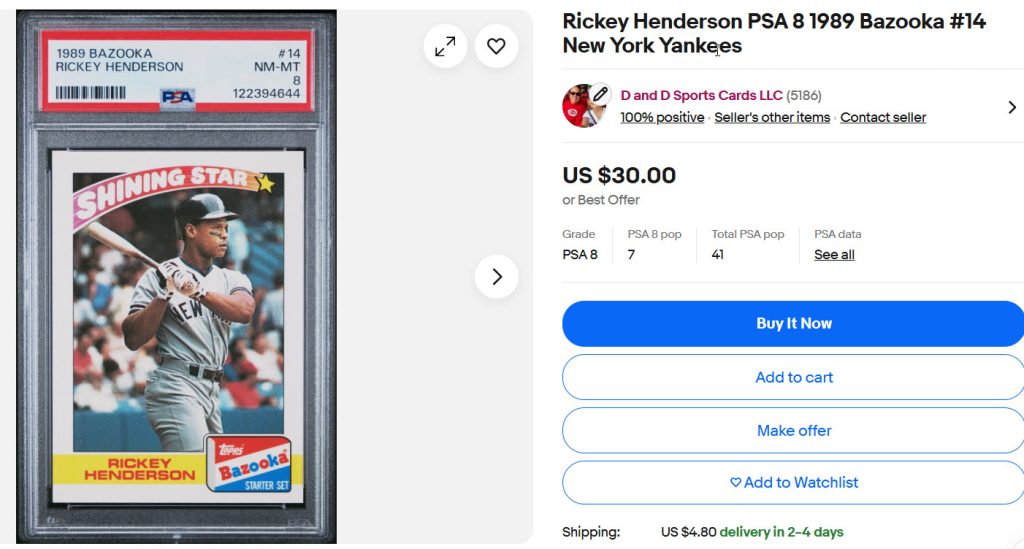
Find Rickey Henderson Graded Bazooka Cards here.
Where to find them today
If you want single cards or complete sets, check eBay, auction sites, and hobby marketplaces—complete 22-card sets frequently appear at low price points. Card shows and local hobby shops often have these in bulk lots or mixed dealer boxes. For condition-sensitive purchases, watch graded auctions (PSA/SGC/BGS) for the best-preserved examples.
Final take
The 1989 Bazooka set is a compact curiosity: not a high-stakes investment, but an enjoyable piece of late-’80s baseball and pop culture. It’s ideal for nostalgia collectors, short-set completers, and anyone who wants a low-cost way to own cards of big names from the era. While not a headline-making rarity, the set’s mix of stars and youngsters, its gum-pack roots, and easy affordability keep it a steady, approachable entry point into vintage baseball card collecting. Many feel this set does not get the respect it deserves and is undervalued in today’s market.
📊 Snapshot — Recent Sale Prices by Card (or Notable Cards)
The table below draws on recent eBay “sold” listings, auction-house data (notably from PSA), and publicly available price guides (e.g. SportsCardsPro, VintageCardPrices).
| Card (# & Player) | Typical Ungraded / Raw Sale Price* | Example Recent Sale / Graded Price / Notes |
|---|---|---|
| #3 — Wade Boggs | From ~$2.09 | PSA-10 (best-case) reportedly as high as ~$124.50 |
| #14 — Rickey Henderson | ~$2.99–$4.00 raw (recent eBay listings) | A PSA-7 graded copy sold for ~$56.25 |
| #13 — Tony Gwynn | ~$1.99–$3.73 raw (recent eBay) | No widely published high-grade “gem mint” price in recent comps. |
| #19 — Gary Sheffield | ~$0.99–$3.50 raw (recent eBay/Beckett listings) | PSA-10 “gem mint” recently sold for ~$125 |
| #5 — Jose Canseco | ~$2.00–$2.50 raw (card-listing sites) | A PSA-10 sold as recently as 2025 for $156.00 |
| Many other cards (Tim Belcher #1, Damon Berryhill #2, Jay Buhner #4, Vince Coleman #6, etc.) | Typically $1.00 –$2.00 in ungraded condition. | Very rarely any graded sales — most are considered lower-value commons |
* “Ungraded / Raw Sale Price” reflects what many copies are selling for on the secondary market as of late 2024–2025.
Full-Set Listings
- Complete 22-card sets in “Near Mint or better” condition have recently sold (or been listed) around US $15 – US $50.00 .
- A particularly well-conditioned “mint-set” (Ungraded) set sold in 2025 at US $100.00 + shipping.
🧮 What This Tells Us: Key Patterns & Market Behavior
– Most cards are low-value commons
As expected for a promotional gum-pack set, the majority of cards — especially non-star or lesser-known players — remain very affordable. Many trade for small change (often $1.00–$2.00) when raw/ungraded.
– Condition & grading dramatically affect value
Cards like Wade Boggs, Gary Sheffield, Rickey Henderson, and Jose Canseco spark the biggest jump when slabbed and graded near-mint or gem-mint. For example, Sheffield’s #19 jumped from ~$1 ungraded to $125 for a PSA-10.Wade Boggs — similarly — shows an advertised PSA-10 “book” value of over $120, though graded sales appear quite rare, another sign that the hobby in general is not paying enough attention to 1989 Bazooka baseball card set.
– Raw vs. graded market remains thin
- Raw or graded copies of star cards like Wade Boggs (#3), Gary Sheffield (#19), Rickey Henderson (#14), Tony Gwynn (#13), and Jose Canseco (#5). In particular, graded PSA 9–10 copies of those tend to show the greatest relative value — especially Sheffield and Boggs.
- Complete 22-card sets in “near mint / very good” condition. Great for budget-conscious collectors, nostalgia builds, or team-set collectors.
Even for the better players, graded cards do not surface often — and when they do, prices vary widely by grade. For everyday raw copies, the low price keeps turnover modest and values stable.
– Complete sets remain inexpensive
Because the whole set is only 22 cards and it is widely available in ungraded copies, complete sets stay accessible sometimes unders $20 depending on the condition. That makes the set a “starter friendly” collectible rather than a high-end investment.
– Rarity isn’t the same as “valuable”
Even though there is limited checklist size (22 cards) and graded high-end copies are rare, that doesn’t automatically translate into high value — likely because of a perception of massive original distribution, low prestige compared with flagship sets, and heavy supply of raw copies.
✅ What’s “Worth Chasing” — and What’s Not
Worth Chasing
Probably Not Worth Much
- Unknowns or lesser names (e.g., Damon Berryhill, Tim Belcher, etc.) — raw copies are cheap, and graded examples rarely surface.
- Buying high-volume raw lots with the expectation they’ll appreciate — because supply remains high, demand modest, and the “junk-wax era” nature of the set limits long-term growth unless a subset of super-high-grade cards becomes extremely scarce (not evident today).
⚠️ Caveats & What This Snapshot Doesn’t Show
- Many “price guides” aggregate data across a long time span; a high “book value” (e.g. Boggs PSA-10 at $124.50) does not guarantee that there are recent sales at or near that number. It may reflect occasional peak sales or optimistic valuations.
- Graded sales are far more sporadic than raw-card sales; absence of recent PSA 9/10/comps doesn’t mean the card cannot fetch higher price — just that the market is thin.
- Price guides (SportscardsPro, VintageCardPrices) may not count every private sale, or may skew toward graded sales; raw values fluctuate with supply.
- Shipping, card condition (center, surface, corners), and grading company all heavily influence final sale price — large spreads are common even among “similar” cards.
🎯 My Take: Where the Value (and Fun) of 1989 Bazooka Lies
The 1989 Bazooka set remains a low-cost, nostalgia-friendly collectible. For someone getting into vintage cards, or building a small-scale collection without massive investment, it’s a good entry point.
If you want “investment potential,” the likely path to meaningful value is:
- Pick out the top-name cards (Boggs, Sheffield, Henderson, Gwynn, Canseco),
- Acquire raw high-quality copies,
- Consider professional grading, to maximize resale potential — though only a few ever resurface as PSA 9/10, so it’s speculative.
For the rest of the cards — and for the “set as a whole” — value will likely remain modest. That said, for many collectors, the emotional and nostalgia value (owning a full “Shining Stars” set) often outweighs raw dollar value.
I
🗂 1989 Bazooka — 22-Card Checklist
1989 Bazooka Card List
| # | Player |
|---|---|
| 1 | Tim Belcher |
| 2 | Damon Berryhill |
| 3 | Wade Boggs |
| 4 | Jay Buhner |
| 5 | Jose Canseco |
| 6 | Vince Coleman |
| 7 | Cecil Espy |
| 8 | Dave Gallagher |
| 9 | Ron Gant |
| 10 | Kirk Gibson |
| 11 | Paul Gibson |
| 12 | Mark Grace |
| 13 | Tony Gwynn |
| 14 | Rickey Henderson |
| 15 | Orel Hershiser |
| 16 | Gregg Jefferies |
| 17 | Ricky Jordan |
| 18 | Chris Sabo |
| 19 | Gary Sheffield |
| 20 | Darryl Strawberry |
| 21 | Frank Viola |
| 22 | Walt Weiss |