
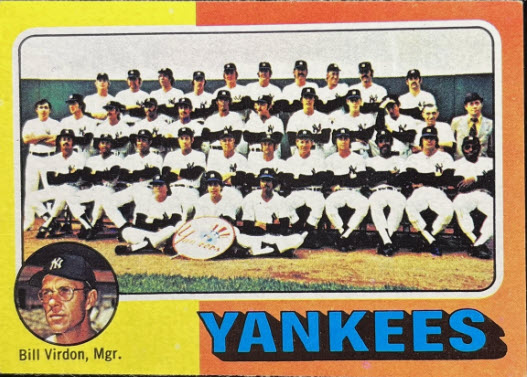
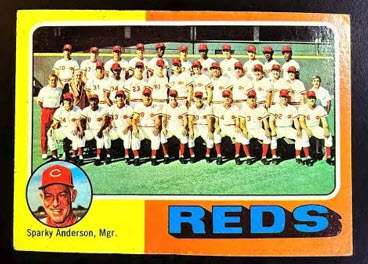
Baseball cards have always been about more than individual stars. While rookie cards and Hall of Famers tend to grab the headlines, team cards—especially those that feature a full photograph of the entire roster—hold a special place in the hobby. From the early days of Topps through iconic issues like the 1975 Topps Cincinnati Reds Team Card (#531), these cards capture something individual player cards simply can’t: the collective identity of a team frozen in time.
In the 1950s and 1960s, Topps regularly included team cards in its flagship sets. These weren’t throw-ins or filler cards. Many featured crisp, posed photographs taken during spring training or at the ballpark, showing players in uniform, often relaxed, sometimes smiling, and occasionally revealing future stars before they became household names. For collectors today, these cards serve as miniature team photos—primary-source snapshots of baseball history.
One of the biggest reasons team cards are so popular is historical context. A single-player card tells you about one career; a team card tells you about a season. It can represent a dynasty, a pennant winner, or a forgotten roster from a rebuilding year. The 1975 Reds team card is a perfect example. That image doesn’t just show players—it captures the core of the “Big Red Machine,” one of the greatest teams in baseball history. Seeing Johnny Bench, Pete Rose, Joe Morgan, and Tony Pérez together in one frame adds emotional and historical weight that no individual card can replicate.
Another major appeal is visual impact. Full-photo team cards feel different in hand. Without heavy borders or action poses competing for attention, the photograph becomes the star. Collectors love studying uniforms, stadium backgrounds, coaching staff, and even the occasional batboy or clubhouse detail sneaking into the frame. These cards reward close inspection, making them ideal for collectors who enjoy the storytelling side of the hobby.
Team cards also attract collectors because of their cross-collectibility. A single card can appeal to multiple audiences at once: team collectors, set builders, vintage photography fans, and player collectors chasing secondary appearances of stars. A rookie appearing on a team card before his first solo issue can add an extra layer of intrigue and value. For some players, their earliest cardboard appearance is actually on a team card.
Scarcity and condition sensitivity play a role too. Team cards were often undervalued in their day and handled less carefully, which makes high-grade examples tougher to find now. Centering can be tricky, and edge wear stands out more on photo-heavy designs. That challenge has only increased their appeal among seasoned collectors who enjoy the hunt for sharp examples.
Finally, there’s a strong nostalgia factor. Team cards feel communal. They remind collectors that baseball is, at its core, a team sport. For fans who grew up following a particular club, owning a clean team card from a favorite era can be just as meaningful—sometimes more so—than owning a star’s individual card.
In a hobby often driven by hype and headlines, baseball team cards offer something deeper: a sense of place, time, and togetherness. That’s why, decades later, collectors are still chasing them—and why full-photo team cards remain quietly iconic.