
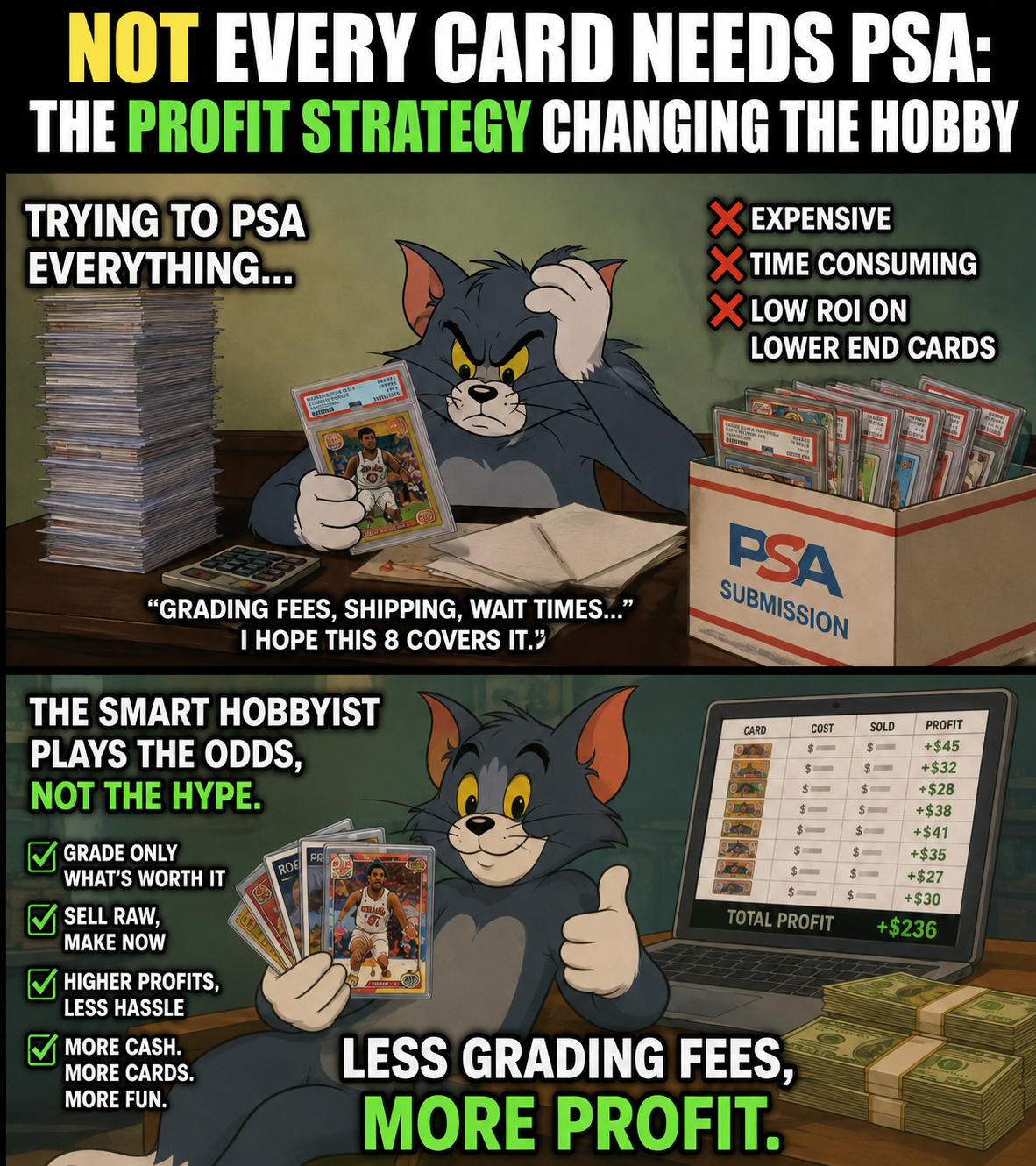
Collectors across the trading card hobby are beginning to rethink the long-standing assumption that every valuable card must be graded by Professional Sports Authenticator. For years, PSA dominated the market because its slabs consistently generated the highest resale prices and the strongest buyer confidence. But the hobby has evolved. Rising grading fees, longer turnaround times, concerns about consistency, and changing collector preferences are driving more submissions toward companies like CGC, Beckett Grading Services, SGC, and newer technology-focused graders such as TAG.
Also less heard of companies like ECC, MPE, & GMA are becoming more popular than ever!
What was once viewed as a risky alternative is now becoming a financially strategic decision for both collectors and dealers.
One of the biggest reasons for this shift is simple economics. PSA grading fees have climbed substantially in recent years, making it difficult for dealers to profit on lower and mid-tier cards. Industry analysis shows PSA bulk submissions can cost significantly more per card once membership fees, shipping, and insurance are included. Meanwhile, CGC and SGC often provide lower-cost grading options with competitive turnaround times. For dealers submitting hundreds or thousands of cards annually, even a savings of $8 to $15 per card dramatically improves margins. A dealer grading 1,000 cards could potentially save well over $10,000 simply by choosing an alternative grading company for the right inventory.
That financial advantage becomes even more important when dealers focus on inventory velocity instead of chasing maximum resale premiums. PSA may still command the highest average sale prices in many categories, but faster turnaround times from competitors allow dealers to flip inventory more quickly and reinvest capital sooner. In business, speed matters. A card sold in 30 days at a slightly lower premium can often outperform a PSA submission that sits in grading for months while market demand changes. Dealers increasingly recognize that consistent cash flow and faster inventory cycles can generate stronger annual profits than waiting for top-dollar PSA returns on every card.
The modern hobby also contains a major segment of collectors who are buying for personal collections rather than pure investment. These collectors often prioritize slab appearance, grading transparency, and affordability over maximizing resale value. Companies like TAG have gained attention for AI-assisted grading reports that provide detailed explanations for each grade, something many collectors feel traditional grading companies have lacked for years. Reddit discussions show growing frustration with subjectivity in grading and appreciation for companies offering more transparent grading methodologies. This shift in collector mindset is helping alternative slabs gain greater acceptance in the secondary market.
Another factor fueling the move away from PSA is growing concern over market concentration within the grading industry. Collectors have become increasingly aware that PSA’s parent company now also owns other major grading brands and auction-related businesses. Critics argue this level of vertical integration creates conflicts of interest and reduces competition in the hobby. Whether or not those concerns materially affect grading outcomes, perception matters in collectibles markets. Many collectors now prefer supporting independent grading companies because they believe competition leads to healthier pricing and greater accountability.
Dealers are also becoming more selective about which grading company matches each type of card. Instead of sending every card to PSA automatically, many experienced sellers now use a tiered strategy. Ultra-high-end vintage cards may still go to PSA because of its resale dominance, while modern Pokémon, sports rookies, or mid-tier collectibles are often submitted to CGC, SGC, or TAG where grading costs are lower and profit margins are stronger. Research from recent grading market studies shows the resale gap between PSA and CGC has narrowed considerably in some categories, especially modern trading card games. In practical terms, if a dealer can save $12 per card in grading fees while only sacrificing a small percentage in resale value, the alternative grader may actually produce more net profit.
The numbers behind grading profitability reinforce this strategy. Studies on grading ROI consistently show that many cards fail to generate meaningful profits once grading fees, shipping, marketplace fees, and grading risk are included. Dealers who focus purely on PSA premiums can overlook the hidden costs associated with slower service levels and higher submission expenses. Smart dealers increasingly analyze expected value instead of relying solely on brand reputation. The question is no longer “Which company sells for the most?” but rather “Which company creates the best return after all costs are considered?”
The hobby itself is also becoming more educated. YouTube creators, grading analysts, and dealer-focused channels are openly discussing profit margins, grading arbitrage, and submission strategy in ways that were less common several years ago. Collectors now understand that grading is fundamentally a business decision. The video referenced in your prompt reflects this growing awareness by highlighting how dealers can maximize profitability through smarter grading choices rather than blindly following hobby tradition. As more collectors share sales data and real-world experiences, alternative grading companies continue gaining legitimacy.
PSA will likely remain the market leader for the foreseeable future, especially in high-end vintage sports and ultra-premium collectibles. However, the hobby is clearly entering a more diversified grading era. Collectors are prioritizing transparency, affordability, and speed, while dealers are focusing on profit optimization and inventory efficiency. In that environment, alternative grading companies are no longer viewed as second-tier options. For many submissions, they are becoming the smarter financial play.