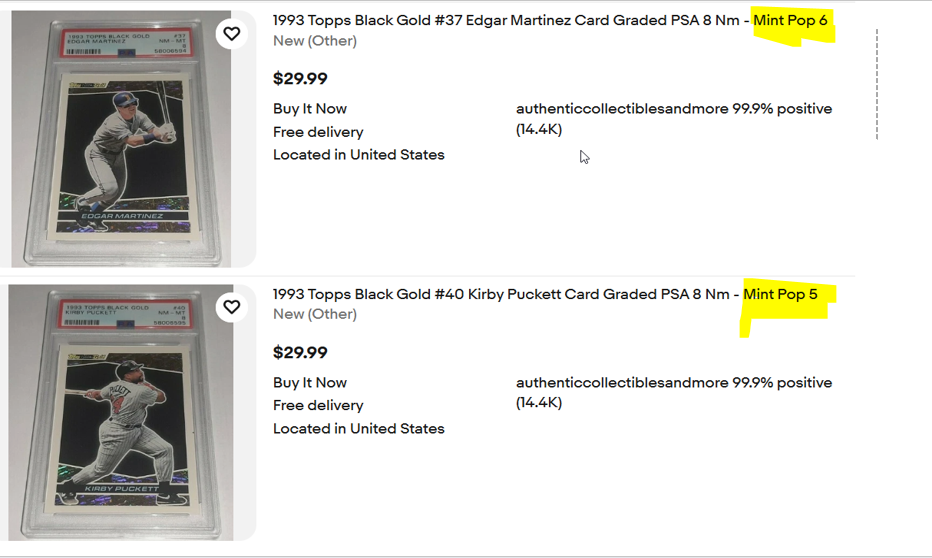
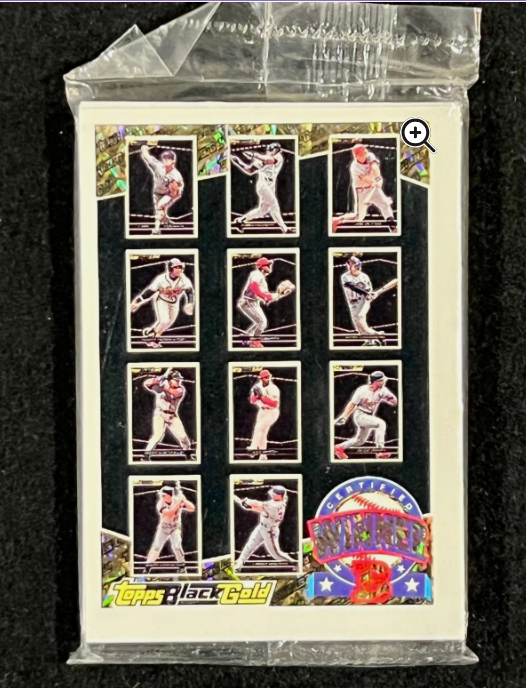
If we have met you at a card show, & you have check out our showcase at D&D Sportscards there is a good chance you saw severl Black Gold Cards. These cards are favorites for many collectiors, and in this article we will share with you the history behind this iconic insert set.
The 1993 Topps Black Gold Baseball insert set remains one of the most memorable and influential baseball card releases of the early 1990s. While many collectors remember the era for its massive print runs and “Junk Wax” reputation, the Black Gold promotion proved that innovation and premium design could still generate excitement in the hobby.
Today, more than 30 years after its release, collectors continue to pursue the complete 1993 Topps Black Gold A, B, C & D Set (#1–44). Featuring Hall of Famers, MVPs, Cy Young winners, and fan favorites, the set combines stunning black-and-gold artwork with one of the hobby’s most creative redemption programs.
Whether you’re a longtime collector, a sports card investor, or someone rediscovering baseball cards from the 1990s, understanding the history of the 1993 Topps Black Gold set helps explain why it continues to enjoy lasting popularity.
The Baseball Card Hobby in 1993
To appreciate the significance of the Black Gold set, it’s important to understand the state of the hobby in 1993.
Baseball cards had experienced explosive growth during the late 1980s and early 1990s. Millions of new collectors entered the hobby, card shops appeared in nearly every city, and manufacturers produced unprecedented quantities of cards.
Competition among manufacturers was fierce. Topps, the industry’s oldest baseball card company, suddenly faced strong competition from Upper Deck, Leaf, Fleer, Donruss, Pinnacle, Score, and Stadium Club. Each company was introducing premium products with glossy finishes, foil stamping, full-color photography, and innovative inserts.
Topps recognized that collectors wanted more than base cards. They wanted cards that felt special.
That realization helped give birth to one of the company’s most successful insert programs.
The Birth of Topps Black Gold
The 1993 Topps Black Gold insert set represented a major milestone for Topps.
Instead of creating another subset hidden within the flagship release, Topps designed an entirely premium insert featuring dramatic photography, elegant black backgrounds, and brilliant metallic gold foil.
Unlike many flashy inserts introduced during the 1990s, Black Gold relied on simplicity.
Each card showcased:
- Rich black gloss
- Metallic gold foil borders
- Sharp player photography
- Clean typography
- Premium cardstock
- Distinctive presentation
The result was one of the best-looking baseball card inserts of its era.
Collectors instantly recognized Black Gold cards when opening packs, making every pull feel like a significant hit.
Why the Black Gold Design Still Looks Modern
One reason collectors continue to admire the 1993 Black Gold set is its timeless appearance.
Rather than relying on colorful geometric patterns that became dated, Topps used a sophisticated color palette built around black and gold.
The design draws your attention directly to the player while the reflective foil adds just enough visual impact without overwhelming the image.
Even by today’s standards, the cards look remarkably clean and elegant.
Many collectors consider them among the best-designed Topps inserts ever produced.
The Complete 44-Card Checklist
The complete Black Gold checklist contains 44 cards featuring many of Major League Baseball’s biggest stars.
The checklist includes future Hall of Famers, Cy Young Award winners, MVPs, and perennial All-Stars.
Among the biggest names are:
- Ken Griffey Jr.
- Nolan Ryan
- Barry Bonds
- Frank Thomas
- Cal Ripken Jr.
- Greg Maddux
- Tom Glavine
- Ryne Sandberg
- Roberto Alomar
- Randy Johnson
- Kirby Puckett
- Tony Gwynn
- John Smoltz
- Robin Yount
- Wade Boggs
For collectors today, the checklist serves as a snapshot of baseball during one of the sport’s most talent-rich eras.
Understanding the A, B, C and D Groups
One aspect that often confuses newer collectors is the lettering system.
Rather than issuing one factory set, Topps divided the checklist into four redemption groups.
Group A
Cards #1–11
Group B
Cards #12–22
Group C
Cards #23–33
Group D
Cards #34–44
Collectors could obtain these groups through special redemption cards inserted into packs.
Some winner cards awarded only a single group, while rarer redemption cards awarded multiple groups or even the complete set.
This promotion created tremendous excitement because collectors never knew exactly what prize they might receive.
The “You’ve Just Won!” Redemption Cards
Perhaps the most innovative aspect of Black Gold was its redemption program.
Collectors opening 1993 Topps Baseball packs occasionally discovered a special “You’ve Just Won!” card instead of a standard insert.
Rather than immediately receiving Black Gold cards, winners mailed the redemption card to Topps with a small postage and handling fee.
Several weeks later, Topps shipped factory-sealed Black Gold packs directly to the collector.
Possible prizes included:
- Group A
- Group B
- Group C
- Group D
- A-B
- C-D
- A-B-C-D complete set
Every redemption also entered collectors into a drawing for one of only 500 framed, uncut Black Gold sheets—a promotion that further enhanced the excitement and collectibility of the set.
At a time before online tracking and instant rewards, waiting for a Topps package in the mail became part of the thrill.
Distribution Methods
Collectors had several ways to acquire Black Gold cards.
Individual inserts appeared in wax packs, jumbo packs, rack packs, and factory sets.
Winner redemption cards could be found throughout the flagship Topps product line.
Collectors who purchased factory sets also received exclusive Black Gold cards included with the complete set.
Because there were multiple ways to build the checklist, completing the full 44-card set became an enjoyable long-term project for many hobbyists.
Ken Griffey Jr.—The Crown Jewel
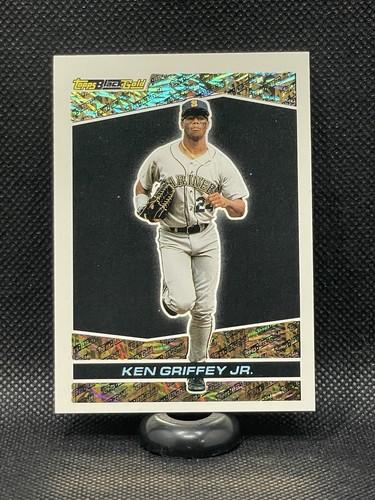
Ask collectors to name the most desirable card in the set, and many will immediately mention Ken Griffey Jr. (#33).
During 1993, Griffey had already become baseball’s biggest superstar.
His effortless swing, spectacular defense, and charismatic personality made him the face of a new generation of Major League Baseball.
The Black Gold Griffey card captures him in action while showcasing the elegant design that made the insert famous.
High-grade examples remain among the most sought-after cards in the entire checklist.
Collectors pursuing PSA 10, BGS 9.5, SGC 10, or other Gem Mint examples often face stiff competition due to the condition-sensitive black borders.
Other Standout Cards
Although Griffey receives most of the attention, numerous other cards remain highly collectible.
Some collector favorites include:
- Nolan Ryan
- Barry Bonds
- Frank Thomas
- Cal Ripken Jr.
- Greg Maddux
- Tony Gwynn
- Randy Johnson
- Roberto Alomar
- Kirby Puckett
- Tom Glavine
Many Hall of Fame player collectors seek Black Gold examples because the design stands apart from ordinary base cards issued during the same period.
Condition Matters
Like many black-bordered cards, Black Gold presents grading challenges.
Collectors should inspect:
- Surface scratches
- Corner wear
- Edge chipping
- Gold foil imperfections
- Print defects
- Centering
Even minor flaws become highly visible against the glossy black finish.
As a result, Gem Mint examples command significant premiums over lower-grade copies.
Professional grading has become an important part of the market for these cards.
Completing a Master Collection
Some advanced collectors pursue more than just the 44-card checklist.
A complete master collection may include:
- All 44 Black Gold cards
- Winner A redemption card
- Winner B redemption card
- Winner C redemption card
- Winner D redemption card
- Winner A-B card
- Winner C-D card
- Winner A-B-C-D redemption card
- Factory-sealed redemption packs
- Original Topps mailing envelope
- Topps congratulatory letter
- Promotional materials
Because many redemption cards were discarded after use, surviving examples have become desirable collectibles in their own right.
Current Collector Interest
Interest in 1990s baseball cards has grown substantially over the past several years.
Collectors who grew up during the hobby boom are now returning with disposable income, creating renewed demand for nostalgic inserts like Black Gold.
The set appeals to several groups:
- Hall of Fame collectors
- Ken Griffey Jr. collectors
- Topps insert collectors
- 1990s baseball card enthusiasts
- Set builders
- High-grade registry collectors
- Sports card investors focused on iconic inserts
This broad collector base has helped maintain steady demand for complete sets and premium graded examples.
Investment Potential
While most 1993 baseball cards remain affordable due to high production numbers, Black Gold occupies a unique niche.
Its attractive design, Hall of Fame checklist, innovative redemption history, and nostalgic appeal have helped separate it from many other inserts of the era.
Although collectors should always buy cards they personally enjoy, complete Black Gold sets continue to attract attention from hobbyists seeking iconic 1990s inserts.
High-grade Hall of Fame players—particularly Ken Griffey Jr., Nolan Ryan, Frank Thomas, Cal Ripken Jr., and Barry Bonds—remain especially popular.
Why the Set Endures
Few insert sets from the early 1990s continue to receive as much appreciation as Black Gold.
Its success stems from several factors:
- Timeless design
- Strong Hall of Fame checklist
- Innovative redemption program
- Premium appearance
- Memorable pack-opening experience
- Strong nostalgic appeal
- Wide collector recognition
Unlike many experimental inserts from the decade, Black Gold never feels gimmicky.
Instead, it represents a tasteful evolution of traditional baseball card design.
Final Thoughts
The 1993 Topps Black Gold Baseball A, B, C & D Set (#1–44) represents a turning point in hobby history. It showed that premium inserts could dramatically enhance the excitement of opening packs while giving collectors something special to chase beyond the standard base set.
Its striking black-and-gold design, creative redemption program, and outstanding roster of baseball legends have allowed the set to remain relevant for more than three decades. Whether you’re assembling the full 44-card checklist, chasing the iconic Ken Griffey Jr. #33, searching for surviving redemption cards, or building a master collection, Black Gold offers a rewarding collecting experience.
In an era often criticized for overproduction, the 1993 Topps Black Gold set stands out as one of the true success stories of the decade. It helped shape the future of modern insert cards and remains a shining example of how thoughtful design and creative marketing can create a lasting hobby classic. For collectors of 1990s baseball cards, the Black Gold set is more than just an insert—it’s an enduring piece of baseball card history.
You can click here, to see many examples of these Classic 93 Topps Black Godl Cards.