
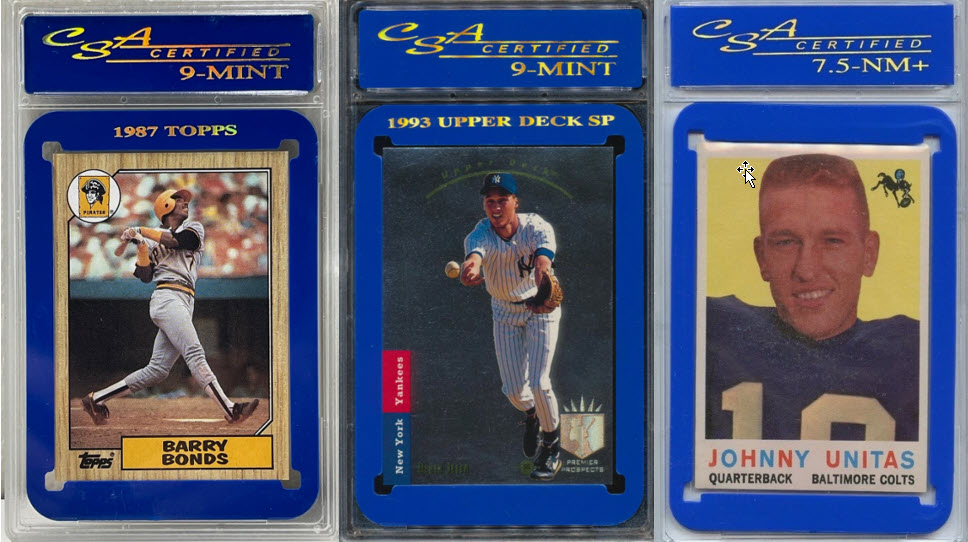
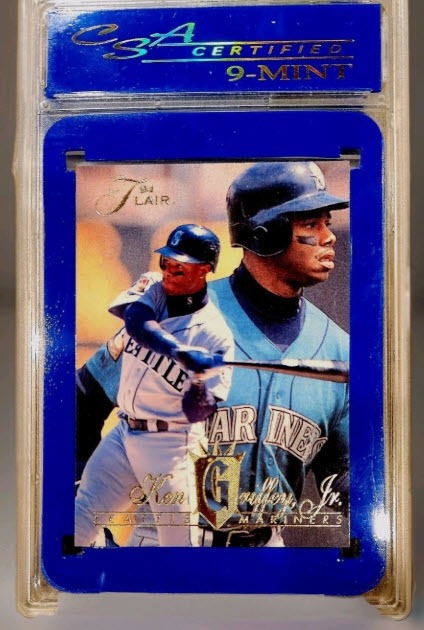
In the history of sports card collecting, certain company names became immortal. Some developed into billion-dollar brands, household names among collectors, investors, and auction houses. Others briefly appeared during periods of explosive growth, attempted to capture a share of the hobby’s momentum, and then slowly vanished into obscurity.
Among those forgotten names was CSA Grading. CSA was the second oldest grading company. They started right after PSA.
For many collectors who participated in the hobby during the late 1990s and early 2000s, the company’s plastic slabs occasionally appeared at card shows, online auctions, dealer tables, and hobby shops. Some collectors remembered the company positively. Others regarded it as one of dozens of grading firms that emerged during the chaotic expansion of third-party authentication. Yet despite the company’s existence within a major era of the hobby, very little formal documentation survives today.
The website once associated with the company, CSAGrading.com, no longer operates. Archived references are sparse. Corporate information is fragmented. Public records are difficult to locate. No major announcement appears to explain exactly when the company ceased operations or why it disappeared.
And yet, the story of CSA Grading is important because it reflects a much larger story: the rise of third-party grading itself, the transformation of sports cards from childhood collectibles into investment assets, and the brutal economic realities that eliminated most grading companies from the marketplace.
To understand CSA Grading, one must first understand the world into which it was born.
The Hobby Before Professional Grading
For much of the twentieth century, sports card collecting was informal. Children traded cards on playgrounds, stored them in shoeboxes, clipped them to bicycle spokes, or tucked them into binders. The condition of a card mattered, but there was no universally accepted system to define quality.
Collectors described cards using vague language:
- Mint
- Near Mint
- Excellent
- Good
- Poor
These descriptions were subjective. One dealer’s “Mint” card might be another dealer’s “Excellent.” Disputes were common. Trust depended heavily on reputation.
During the 1970s and 1980s, the sports memorabilia market expanded rapidly. Baseball cards in particular began attracting serious adult collectors. Prices for vintage cards rose dramatically. The famous 1909 T206 Honus Wagner card became symbolic of the growing financial value of collectibles.
As prices increased, so did the need for standardization.
Collectors wanted answers to difficult questions:
- Was a card authentic?
- Had it been altered?
- Was it trimmed?
- Was the autograph real?
- Was the condition accurately described?
By the late 1980s, the hobby desperately needed independent third-party verification.
That need created the grading industry.
The Birth of Third-Party Grading
The modern grading industry effectively began when Professional Sports Authenticator entered the market in 1991 under the ownership of Collectors Universe.
PSA introduced several revolutionary concepts:
- standardized numeric grades,
- tamper-evident holders,
- population reports,
- and independent authentication.
Collectors no longer needed to rely solely on a seller’s opinion. A professionally graded card became easier to trust, easier to insure, and easier to resell.
The PSA scale from 1 to 10 quickly became influential:
- PSA 10 Gem Mint
- PSA 9 Mint
- PSA 8 Near Mint-Mint
- and so on.
This transformed cards into standardized financial assets.
Soon other companies entered the market.
Among the most important competitors was Beckett Grading Services, launched by Beckett Media in 1999. Beckett already possessed enormous authority through its price guides, making its transition into grading highly influential.
Meanwhile:
- SGC specialized in vintage cards,
- Global Authentication appeared,
- GAI entered the market,
- and numerous smaller firms attempted to establish themselves.
This environment created the conditions for companies like CSA Grading to emerge.
The Era of Grading Expansion
The late 1990s and early 2000s represented one of the most turbulent periods in sports card history.
Several forces collided simultaneously:
1. The Speculation Boom
Collectors increasingly viewed cards as investments rather than toys.
Rookie cards of stars such as:
- Ken Griffey Jr.
- Michael Jordan
- Kobe Bryant
- Tom Brady
began appreciating significantly in value.
Condition became everything.
A tiny imperfection could reduce a card’s price dramatically. Consequently, grading companies became increasingly powerful.
2. Internet Commerce
The emergence of online auction platforms fundamentally changed the hobby.
Before online selling, buyers usually examined cards in person. After the rise of internet marketplaces, collectors purchased cards from strangers across the country.
Grading solved the trust problem.
A PSA 9 card could theoretically be purchased confidently without physical inspection because the grading company acted as intermediary.
3. Manufacturing Complexity
Card manufacturers introduced:
- refractors,
- serial-numbered parallels,
- autograph inserts,
- memorabilia cards,
- patch cards,
- and short prints.
Authenticity became increasingly important.
4. Counterfeiting and Alteration
As card prices rose, fraud became more profitable.
Collectors worried about:
- trimmed edges,
- recolored borders,
- fake autographs,
- resealed packs,
- counterfeit vintage cards.
Authentication services became essential.
The result was explosive demand for grading.
And wherever demand explodes, new companies appear.
The Emergence of CSA Grading
Within this expanding marketplace emerged CSA Grading.
Evidence suggests the company operated under the name “Canadian Sports Authenticator Inc.” and offered:
- sports card grading,
- memorabilia authentication,
- encapsulation services,
- and possibly unopened pack grading.
The surviving traces of the company indicate it positioned itself as an alternative to the dominant grading firms.
At the time, this was not unusual.
Many grading companies believed there was room in the market for competitors because:
- grading demand was skyrocketing,
- submission backlogs were growing,
- and collectors were searching for lower-cost alternatives.
The barrier to entry appeared deceptively low.
A company needed:
- grading standards,
- slab manufacturing,
- label printing,
- authentication personnel,
- and dealer relationships.
But long-term success required something far more difficult:
Trust.
And trust in collectibles is extraordinarily difficult to build.
What CSA Attempted to Become
Although formal corporate records are limited, surviving slabs and collector discussions reveal several likely goals behind CSA Grading’s business model.
Building Credibility Through Encapsulation
CSA used hard plastic holders similar to competitors.
The slab itself was psychologically important.
Collectors viewed encapsulated cards differently than raw cards because slabs conveyed:
- permanence,
- professionalism,
- security,
- and legitimacy.
The slab became part of the product.
Competing on Price
Smaller grading firms often attempted to undercut larger competitors.
PSA and Beckett submissions could become expensive, especially during grading booms. Emerging companies frequently marketed:
- faster turnaround times,
- lower submission fees,
- bulk discounts,
- and dealer programs.
CSA likely pursued similar strategies.
Serving Regional Markets
Many smaller grading companies succeeded temporarily by focusing on specific geographic regions.
CSA’s Canadian identity may have provided advantages among Canadian dealers and collectors, particularly in hockey card markets.
That mattered because hockey collecting has always maintained especially strong cultural importance in Canada.
Cards involving:
- Wayne Gretzky
- Mario Lemieux
- Patrick Roy
generated substantial demand.
A Canadian-based grading service may have appeared attractive to regional collectors seeking lower shipping costs and localized expertise.
Establishing Market Recognition
Like all grading companies, CSA needed collectors to believe:
- the grades were accurate,
- the slabs were secure,
- and the company would survive long term.
Without those three elements, resale values suffer.
That challenge proved fatal for many firms.
The Grading Wars
The sports card grading industry eventually became crowded beyond sustainability.
Dozens of companies entered the field:
- PSA
- BGS
- SGC
- GAI
- PRO
- GEM
- ASA
- CSA
- and many others.
Some were legitimate operations attempting to maintain standards.
Others developed reputations for inflated grading.
This era became known informally among collectors as part of the “grading wars.”
The problem was straightforward:
If collectors distrusted a grading company’s standards, cards inside its slabs sold for less money.
This created a vicious cycle:
- Lower market trust
- Lower resale value
- Fewer submissions
- Reduced revenue
- Less market presence
- Eventual collapse
The entire grading industry became dominated by perception.
In many cases, collectors valued the brand on the slab more than the card itself.
A PSA 10 could command vastly higher prices than an identical card graded by a lesser-known company.
That network effect became almost impossible for smaller firms to overcome.
Why Collectors Chose the Major Companies
The grading market eventually consolidated around a handful of dominant firms because collectors prioritized several critical factors.
Liquidity
Collectors wanted cards that could easily be sold.
Auction houses preferred PSA, BGS, and SGC because buyers trusted them.
A card graded by a small company might require:
- explanation,
- cross-grading,
- or discounted pricing.
Population Reports
Major grading companies maintained detailed databases showing:
- how many copies existed,
- how many achieved each grade,
- and rarity statistics.
This information influenced investment decisions.
Smaller firms often lacked robust population reporting systems.
Registry Competition
PSA’s Set Registry transformed collecting into competition.
Collectors competed for highest-rated sets.
This created powerful incentives to use PSA specifically.
Smaller firms could not replicate that ecosystem.
Market Psychology
Collectors developed emotional loyalty to certain brands.
The slab became symbolic.
PSA represented investment legitimacy.
BGS represented modern-card prestige.
SGC represented vintage expertise.
Smaller firms struggled to establish comparable identities.
CSA entered this highly competitive battlefield during a period when consolidation was accelerating.
The Challenges Facing CSA Grading
Although little direct documentation survives, the broader economics of the grading industry make CSA’s likely struggles easier to understand.
1. Brand Recognition
Building trust takes years.
Collectors are conservative regarding authentication because mistakes can cost enormous amounts of money.
Without widespread hobby recognition, smaller grading firms faced skepticism immediately.
2. Capital Requirements
Running a grading company is expensive.
Costs include:
- secure facilities,
- insurance,
- authentication staff,
- customer service,
- slab production,
- software systems,
- shipping infrastructure,
- fraud prevention.
As the hobby matured, these costs increased dramatically.
3. Consistency
Collectors closely monitor grading consistency.
If a company appears:
- too strict,
- too lenient,
- or inconsistent,
its reputation suffers rapidly.
Maintaining consistency across thousands of submissions is extremely difficult.
4. Secondary Market Acceptance
The secondary market effectively determines whether a grading company survives.
If buyers consistently discount a company’s slabs, submitters stop using the service.
That appears to have happened to many smaller firms.
5. Industry Consolidation
Eventually the hobby consolidated around:
- PSA,
- Beckett,
- and SGC.
Once that occurred, smaller firms found it increasingly difficult to compete.
The Problem of Perception
One of the most fascinating aspects of the grading industry is that value depends heavily on collective belief.
A card inside a slab is still the same card physically.
Yet collectors may value identical cards radically differently depending on the company label.
This phenomenon resembles:
- currency systems,
- luxury branding,
- or financial ratings agencies.
The slab itself functions partly as a trust certificate.
Collectors frequently cracked cards out of smaller-company slabs and resubmitted them to PSA or BGS hoping for stronger resale value.
This practice damaged smaller grading firms because:
- their slabs disappeared from circulation,
- population data weakened,
- and market visibility declined.
CSA likely experienced this phenomenon.
The Internet Remembers Everything — Except Some Companies
One remarkable aspect of CSA Grading’s disappearance is how little information survived online.
This reflects the early internet era.
Many businesses in the late 1990s and early 2000s:
- lacked robust digital archives,
- used primitive websites,
- and disappeared before social media documentation became common.
When domains expired, enormous amounts of history vanished.
Archived references indicate that CSAGrading.com once functioned as the company’s public face, advertising grading and authentication services.
Today the site is inactive.
This disappearance itself tells an important story about internet-era businesses:
many existed intensely but briefly, leaving behind little more than:
- dead links,
- forum discussions,
- and surviving products.
CSA’s remaining slabs now function almost like archaeological artifacts from an earlier stage of hobby history.
Collector Memories and Hobby Reputation
Modern references to CSA largely survive through collector discussions.
Many hobbyists today encounter CSA slabs accidentally:
- at estate sales,
- flea markets,
- old collections,
- or online auction listings.
Reactions are mixed.
Some collectors remember CSA as a legitimate smaller firm attempting to compete honestly.
Others associate it with the flood of lesser-known grading companies that emerged during speculative periods.
Importantly, hobby reputation often becomes self-reinforcing.
If enough collectors lose confidence in a grading company:
- dealers stop accepting submissions,
- auction houses stop featuring the slabs prominently,
- resale values decline,
- and the company enters a downward spiral.
This appears to have affected numerous grading firms from that era.
The Importance of Timing
Timing is everything in collectibles.
CSA operated during an especially difficult transition period.
The company appears to have emerged after grading had already become important but before market dominance fully consolidated.
That timing created opportunity—but also danger.
By the early 2000s:
- PSA had enormous market share,
- Beckett possessed strong brand authority,
- and SGC had developed niche credibility.
The remaining market became increasingly difficult to penetrate.
Collectors tend to prefer stability in authentication markets because:
- collections may represent life savings,
- investment portfolios,
- or emotionally significant assets.
A collector considering a grading submission often asks:
“Will this company still exist in ten years?”
That question alone destroyed many smaller firms.
The Economics of Trust
The grading industry is fundamentally built on trust economics.
Unlike manufacturing businesses, grading companies do not create the collectible itself.
Instead, they create:
- confidence,
- standardization,
- and market legitimacy.
That means perception becomes everything.
A grading company can possess:
- skilled graders,
- fair standards,
- quality slabs,
- and efficient service,
yet still fail if the market does not embrace its brand.
This is one reason why the industry eventually concentrated so heavily around a few dominant players.
Collectors wanted:
- universal acceptance,
- auction compatibility,
- and long-term stability.
Smaller firms struggled to provide those assurances.
Why Some Grading Companies Vanished
CSA was far from alone.
Many grading companies disappeared over the years.
Some collapsed because of:
- financial instability,
- insufficient submissions,
- legal troubles,
- inconsistent grading,
- counterfeiting concerns,
- or inability to compete.
Others simply faded away quietly.
Unlike publicly traded corporations, many small grading companies left little corporate documentation.
Their shutdowns were often informal:
- websites expired,
- phones disconnected,
- submissions stopped,
- employees moved on.
The hobby moved quickly.
Collectors focused on surviving brands.
The Consolidation of the Hobby
By the 2010s, the grading market had largely consolidated around major leaders.
PSA became especially dominant.
Several factors contributed:
- registry systems,
- investor confidence,
- auction integration,
- celebrity collectors,
- and explosive price growth.
The rise of ultra-high-end auctions further strengthened the largest firms.
Cards selling for:
- six figures,
- seven figures,
- or more
required maximum buyer confidence.
Smaller grading companies increasingly became marginalized.
Many collectors viewed them primarily as:
- budget options,
- regional services,
- or candidates for crossover submissions.
This environment left little room for companies like CSA.
The Pandemic Boom and Historical Reassessment
Ironically, the sports card explosion during the COVID-19 pandemic renewed interest in forgotten grading companies.
As PSA submission volumes surged into the millions, turnaround times became enormous.
Collectors revisited alternative graders.
Old slabs resurfaced online.
Some collectors began studying historical grading companies as artifacts of hobby history.
CSA slabs occasionally appeared in:
- YouTube videos,
- collector forums,
- nostalgia discussions,
- and crossover experiments.
This renewed attention highlighted how many grading firms once existed during the hobby’s expansion years.
Could CSA Have Survived?
An interesting historical question is whether CSA could have survived under different circumstances.
Several possibilities emerge.
Specialization
Some smaller grading firms survive by focusing narrowly on:
- vintage cards,
- regional markets,
- niche collectibles,
- or low-cost bulk grading.
Perhaps CSA might have succeeded through specialized Canadian hockey expertise.
Strategic Partnerships
Partnerships with major auction houses or dealers can dramatically improve visibility.
Without those relationships, growth becomes difficult.
Technological Innovation
Modern grading increasingly involves:
- AI-assisted analysis,
- digital imaging,
- blockchain discussions,
- and advanced anti-counterfeiting measures.
Earlier adoption of innovative technology might have differentiated smaller firms.
Brand Development
Ultimately, grading success depends heavily on branding psychology.
Companies that survive become symbols of trust.
Building that symbolism requires enormous consistency and market visibility.
The Legacy of Forgotten Grading Companies
Although CSA disappeared, companies like it played an important role in hobby history.
They reveal:
- how explosive the grading boom became,
- how fragmented the market once was,
- and how uncertain the industry remained during its formative years.
Every surviving CSA slab represents evidence of that era.
Collectors today often forget how unstable the hobby once appeared.
Modern grading dominance can make PSA or BGS seem inevitable.
They were not inevitable.
The market once contained enormous uncertainty.
CSA existed during that uncertainty.
The Human Side of the Story
Behind every grading company were real people:
- entrepreneurs,
- collectors,
- dealers,
- authenticators,
- and employees.
Some likely believed deeply in the company’s future.
Launching a grading company required optimism.
The founders of CSA almost certainly recognized the hobby’s growth potential and believed they could compete in an expanding marketplace.
At the time, that belief may not have seemed unreasonable.
The industry was booming.
Collectors were spending heavily.
Demand for authentication was rising rapidly.
Many entrepreneurs saw opportunity.
Most failed.
The Difficulty of Historical Reconstruction
One reason CSA fascinates modern collectors is the mystery surrounding it.
The lack of surviving documentation creates challenges:
- exact founding dates remain unclear,
- executive identities are uncertain,
- operational timelines are incomplete,
- shutdown details are elusive.
This absence of information itself reflects broader digital-history problems.
Countless early internet-era businesses effectively disappeared from historical memory because:
- archives were not preserved,
- websites vanished,
- records remained private,
- and media coverage was limited.
CSA became one of those lost companies.
The Emotional Nature of Collecting
Sports card collecting has always involved emotion as much as economics.
Collectors remember:
- childhood experiences,
- favorite athletes,
- family traditions,
- local card shops,
- and old collections.
When hobbyists encounter CSA slabs today, they often experience nostalgia for an earlier collecting era.
The slab becomes more than plastic.
It becomes a time capsule.
It recalls:
- mall card shows,
- early eBay auctions,
- handwritten submission forms,
- and the experimental atmosphere of the grading boom.
In this sense, CSA remains part of hobby history even if the company itself no longer exists.
The Broader Story of Authentication
The rise and fall of CSA also reflects a broader societal trend:
the increasing importance of third-party authentication.
Modern society relies heavily on intermediaries of trust:
- credit agencies,
- certification bodies,
- app verification systems,
- financial auditors,
- and digital security firms.
Sports card grading belongs to that same category.
Collectors outsource trust to experts.
This creates enormous power for authentication companies—but also enormous pressure.
One scandal or credibility failure can destroy confidence rapidly.
Smaller firms often lacked the resources to survive such pressures.
The Current State of the Industry
Today the grading industry is far larger and more sophisticated than during CSA’s apparent operational years.
Modern grading includes:
- advanced imaging,
- database integration,
- online verification,
- QR-code tracking,
- AI analysis,
- and massive submission centers.
Cards routinely sell for:
- hundreds of thousands,
- or even millions of dollars.
Institutional investors now participate in the hobby.
The industry became professionalized at a scale difficult to imagine during the early grading era.
Companies like CSA belonged to a transitional stage between:
- informal collecting culture
and - fully financialized collectibles markets.
Why CSA Still Matters
Even though CSA disappeared, its story matters historically because it illustrates several important truths.
Markets Reward Trust Ruthlessly
Collectors ultimately concentrated around companies perceived as safest.
Booming Industries Create Temporary Competitors
Rapid expansion attracts newcomers, but most eventually disappear.
Digital History Is Fragile
Entire businesses can vanish almost completely from public memory.
Collectibles Are Cultural Artifacts
Old slabs preserve historical moments within the hobby.
Brand Power Can Surpass Technical Skill
Even competent companies may fail if the market does not embrace them psychologically.
CSA represents all these dynamics simultaneously.
The Mystery of the End
The exact circumstances surrounding CSA Grading’s closure remain unclear.
No widely publicized statement appears easily accessible explaining:
- when operations ceased,
- whether the company dissolved formally,
- or why the website disappeared.
This silence is surprisingly common among small hobby-era businesses.
Some possibilities include:
- declining submissions,
- inability to compete,
- rising operational costs,
- market consolidation,
- ownership changes,
- or simple financial exhaustion.
Without surviving corporate records, certainty is impossible.
But the broader historical forces affecting the grading industry strongly suggest that market consolidation likely played a major role.
Final Reflections
The story of CSA Grading is not merely the story of one forgotten company.
It is the story of:
- a transforming hobby,
- speculative booms,
- technological change,
- internet commerce,
- and the economics of trust.
CSA existed during one of the most volatile and important eras in sports card history. It emerged when grading was still developing, when competition seemed possible, and when entrepreneurs believed new companies could establish themselves alongside rising giants.
For a time, CSA slabs circulated through the hobby ecosystem. Collectors submitted cards. Dealers sold inventory. Authenticators evaluated collectibles. The company participated in the massive cultural shift that transformed sports cards from childhood entertainment into globally traded assets.
Then, gradually, the company faded from view.
Today, the surviving evidence is fragmented:
- old slabs,
- archived references,
- hobby memories,
- and dead web domains.
Yet even in disappearance, CSA remains historically meaningful.
Its rise and decline illustrate how quickly industries evolve, how brutally markets consolidate, and how difficult it is to build enduring trust in a world driven increasingly by authentication and reputation.
In the end, perhaps the most fascinating aspect of CSA Grading is not simply that it existed—but that it almost disappeared from memory entirely.
And yet, among collectors, every forgotten slab still tells part of the story.